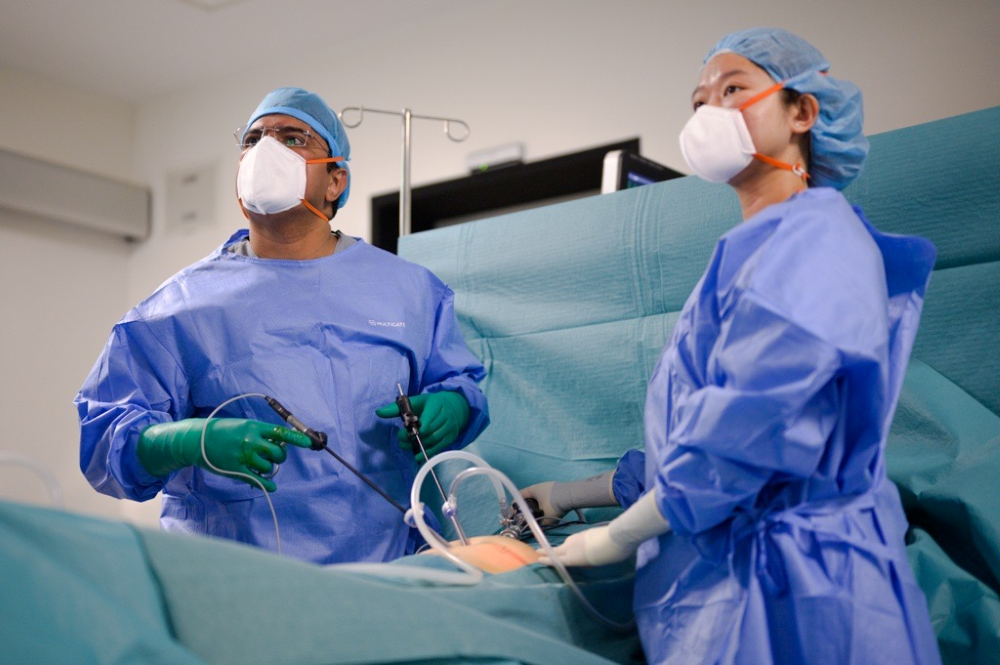
Hernia Surgery in Alexandra Hospital focuses on providing comprehensive treatment for different types of abdominal wall hernia. Our multidisciplinary group of hernia specialists utilises a wide variety of surgical techniques and some of these advanced techniques originated from our own operating theaters in Alexandra Hospital.
What Is a Hernia?
A hernia occurs when part of an internal organ or fatty tissue pushes through a weakened area or tear in the muscles of the abdominal wall, resulting in a visible bulge beneath the skin. The weakness may be present from birth or develop over time due to ageing, previous surgery, pregnancy, repeated straining, or increased pressure within the abdomen.
The most common sign of a hernia is a soft swelling or lump that may become more noticeable when standing, walking, coughing, lifting heavy objects, or straining. It may reduce in size or disappear when lying down. While some people experience little or no discomfort, others may develop pain, aching, or a feeling of heaviness around the affected area, particularly after prolonged physical activity.
Although some hernias may initially cause only mild symptoms, they do not heal on their own and often enlarge over time if left untreated. Hernia repair surgery is the only definitive treatment to repair the weakened abdominal wall, relieve symptoms, and reduce the risk of complications.
What Are the Different Types of Hernias That We Treat?
Hernias are named according to their location on the abdominal wall or occasionally, their specific cause.
- Groin Hernia: There are two types of groin hernias - Inguinal and Femoral. Inguinal hernia is the most common type of hernia and has two varieties - Indirect and Direct. Indirect hernia occurs through the groin in an area on the muscle where the male testis pierces and descends during foetal development. Femoral hernia is more common in women and is known to cause acute problems.
- Umbilical Hernia: This is one of the most common hernias. Women are more commonly affected than men - likely due to a previous pregnancy. This area is particularly weak because of the umbilical cord attachment during birth.
- Incisional Hernia: This form of hernia develops at the site of previous surgical incisions. The muscles around the incision site becomes weak and may lead to hernia formation. At times, multiple areas of weakness may develop with multiple hernias along the entire length of the scar and these can develop weeks, months or years after the initial surgery. Every subsequent surgery further weakens the muscle and increases the risk of hernia formation.
- Midline Ventral Hernia: This can be epigastric (in upper abdomen), para-umbilical (around the umbilicus), supra-pubic (in lower abdomen) and sub-xiphoid (just below the rib cage in the midline).
- Spigelian Hernia: This occurs through the spigelian fascia which is just beside the rectus muscles of the abdomen. The hernia lies in between two muscles of the abdominal wall and is hence difficult to diagnose clinically. The surgeon may need to perform an ultrasound or computed tomography (CT) scan.
- Hiatal Hernia: This occurs when an organ, typically the stomach protrudes through the oesophageal opening in the diaphragm.
- Rare Hernia: This includes lateral hernia, obturator hernia, lumbar hernia, sub-xiphoid hernia and parastomal hernia.
Hernia Symptoms
The symptoms of a hernia can vary depending on its size, location, and whether complications have developed. The most common sign is a visible or palpable bulge in the abdomen or groin that may become more noticeable when standing, coughing, lifting heavy objects, or straining. Some people experience little discomfort, while others may notice aching, burning, or a feeling of heaviness around the affected area. Pain may worsen during physical activity and improve when lying down or resting.
Although many hernias are not immediately dangerous, certain symptoms require urgent medical attention. If the bulge becomes firm and cannot be pushed back into the abdomen, or if it is accompanied by sudden severe pain, redness or discolouration of the skin, nausea, vomiting, fever, or abdominal bloating, it may indicate that the hernia has become incarcerated or strangulated. This is a medical emergency that requires prompt surgical treatment.
Who Is at Risk of Developing a Hernia?
Although anyone can develop a hernia, certain individuals have a higher risk than others. Men are more likely to develop inguinal hernias, while people with obesity or weakened abdominal muscles are generally more susceptible to abdominal wall hernias. The likelihood of developing a hernia also increases with age, as muscles naturally lose strength and elasticity.
People whose occupations or daily activities involve frequent heavy lifting or prolonged standing may be at greater risk because these activities repeatedly increase pressure within the abdomen. Individuals with chronic cough, long-term constipation, previous abdominal surgery, or a family history of hernias may also have an increased risk of developing a hernia.
How Is a Hernia Diagnosed?
Hernia can be diagnosed in most cases through a physical examination. In recurrent hernia, complex cases or in certain group of patients (e.g. obese, patient with previous surgery), an Imaging Diagnosis (Ultrasound, CT scan, MRI) may be necessary. Most hernias need to be repaired surgically to treat symptoms and prevent complications (e.g. strangulation of the intestine). Truss or abdominal binders are temporary measures for patients awaiting surgery or for very high-risk patients.
When Is Hernia Surgery Needed?
Patients with small hernias that cause few or no symptoms may not require immediate surgery. During this time, your doctor will monitor the hernia to ensure it is not increasing in size or causing complications.
However, hernia repair surgery is generally recommended when the hernia causes pain or discomfort, interferes with daily activities, continues to enlarge, or becomes increasingly difficult to push back into the abdomen. Surgery is also advised if there is concern that the hernia may become incarcerated or strangulated, as these complications can restrict blood flow to the trapped tissue and require emergency treatment.
Hernia Repair Surgery at Alexandra Hospital
At the Alexandra Hospital, besides Open and Laparoscopic (Keyhole) Surgery, we perform surgical techniques such as Enhanced-view Totally Extraperitoneal (eTEP) repair for ventral and incisional hernia, Modified Totally Extra-Peritoneal (mTEP) repair of large groin hernia, Totally Extra-Peritoneal Plus (TEP+) for large direct groin hernia, Single Incision Laparoscopic (SILS) Hernia Repair, advanced local anaesthesia technique for groin hernia repair (NATURE) and Muscle Release surgeries such as Endoscopic Component Separation and Transversus Abdominis Release, among others.
Open Hernia Repair
During open surgery, a single incision is made over the hernia. The protruding tissue is returned to the abdomen, and the weakened muscle is repaired. Surgical mesh is often used to reinforce the abdominal wall and reduce the risk of recurrence.
Laparoscopic Hernia Repair
Minimally Invasive Hernia Surgery also known as Laparoscopic (Keyhole) Surgery is performed through several small incisions using specialised instruments and a camera. Compared with open surgery, this minimally invasive approach results in less postoperative pain, smaller scars, and a faster return to normal activities in suitable patients.
Suitable treatment options are discussed with the patient after a thorough examination.
Preparing for Hernia Surgery
Before surgery, your surgeon will review your medical history, medications, and overall health to ensure you are suitable for the procedure. You may also undergo blood or imaging tests, depending on your condition. Your healthcare team will provide instructions on how to prepare for surgery, including fasting, adjusting certain medications, and what to expect on the day of the procedure and during recovery.
Recovery After Hernia Surgery
Recovery after hernia repair surgery varies depending on the type of hernia, surgical approach, and your overall health. Most patients are encouraged to walk soon after surgery to promote healing. Mild pain, bruising, or swelling is common and usually improves within a few days. Your surgeon will advise you on wound care, pain management, and when it is safe to resume work, exercise, driving, and other daily activities. Patients who undergo laparoscopic hernia repair may experience a quicker recovery than those who undergo open surgery and most of these patients go home on the same day after surgery and usually do not require any additional care at home.
Possible Risks and Complications
Hernia repair surgery is generally safe, but like all surgical procedures, it carries some risks. These may include bleeding, infection, bruising, chronic pain, hernia recurrence, or, in rare cases, complications related to surgical mesh. Your surgeon will discuss the potential benefits and risks with you and provide guidance on post-operative care to support smooth recovery.