What Is Cataract?
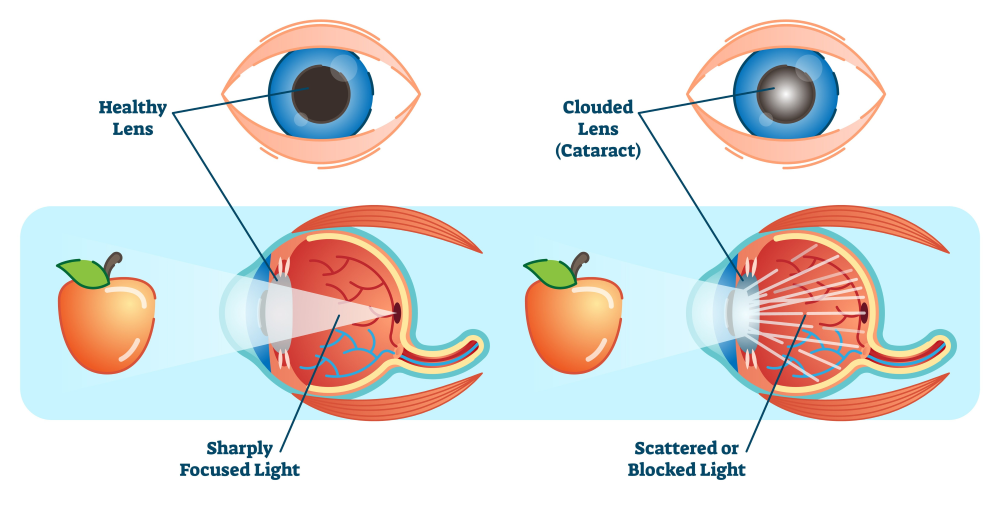
Behind the iris – the coloured part of the eye – is the lens. This is a transparent disc behind the iris that focuses incoming light rays to form a sharp, distinct image on the retina. The lens and retina function in the same way that a camera lens would focus an image onto film.
When a cataract occurs, the lens clouds and loses its transparency. The cloudy lens prevents light rays from entering the eye and passing onto the retina, impairing vision. Having a cataract is similar to having a dirty and smudged camera lens, which can make the image cloudy or foggy and sometimes blurry.
What Are the Symptoms of Cataract?
The extent to which your vision is affected depends on the severity of your cataract. Some symptoms of cataract include:
- Blurry or unfocused vision
- Difficulty seeing clearly when you are in places with bright lights or harsh sunshine because of the glare.
- Double vision.
- Changes in the quality of your vision.
- Difficulty seeing details such as bus numbers or faces across the street outside on sunny days.
- Oncoming headlights can be glaring and uncomfortable.
- You may have trouble reading even with your best pair of spectacles or find that you need to change the prescription of your spectacles frequently. If this is the case, it is likely that you have advanced cataract.
How Will My Eyes be Examined for Cataract?
When you come in for your outpatient appointment, you will have a sight test followed by a full eye examination. Your ophthalmologist will administer eye drops to dilate your pupils and conduct a comprehensive eye examination
You will find that these eye drops temporarily blur your vision. Because of this, you are advised to move around slowly and carefully. Reading will be difficult, and you should also avoid driving on the day of your appointment.
How Is Cataract Treated?
The only effective treatment for cataract is a small operation to remove the cloudy lens and replace it with a lens implant.
If your cataract is mild, a change in your spectacles, stronger bifocals, or the use of magnifying glasses may improve your vision to an acceptable level.
Although this will not resolve your cataract, it will postpone the need for surgery. If your cataract is advanced enough to severely affect your lifestyle, you may consider an operation to replace your clouded lens.
What Are the Types of Intraocular Lens (IOL) Available?
Intraocular Lens (IOL) is a tiny, lightweight clear plastic disc made of silicone or acrylic. It replaces the focusing power of the eye’s natural lens. There are three kinds of lenses available at AH Eye Surgery Centre. Suitability for the lenses are based on your eye condition(s) and needs, which will be discussed with you during your visit.
Monofocal Intraocular Lens (IOL)
A standard lens to correct for distance. However, reading glasses will still be required.
Extended Depth of Focus Lens (EDOF)
This lens corrects for distance vision, as well as provide some functional near vision for daily activities. This aims to decrease some dependence on reading glasses. However, reading glasses may still be required for intensive near tasks, such as reading small print etc.
Multifocal Intraocular Lens (IOL)
It helps the eye to focus at various distances, allowing the wearer to see both near and far objects clearly. Some patients may require a period of time for adaptation to the new lens and may notice haloes and decreased contrast in certain situations.
Toric Intraocular Lens (IOL)
An Intraocular Lens (IOL) that corrects astigmatism.
What Will Happen During the Cataract Surgery?
Cataract surgery is the most common procedure carried out by eye doctors. It is known to have a low complication rate of less than 1%. It typically lasts between 20 to 45 minutes and can be performed as a day procedure. . There is no need for hospitalisation, and you can go home on the same day.
Cataract usually does not recur after surgery, although, in a few cases, the lens capsule holding the intraocular lens may become cloudy and cause vision to deteriorate months or years later. However, this can be treated with an outpatient laser procedure called Yag Capsulotomy.
Before Surgery
Eye investigations are done to determine the strength of your lens implant required. You may also need to have blood tests, a chest X-ray and ECG (electrocardiogram) to check your fitness for operation.
During Surgery
Before surgery, eyedrops are given to dilate the pupil. Normally, cataract surgery is performed with a local anaesthetic – this may be in the form of eyedrops or an injection that will numb your eye. You will be awake, but the surgery will be painless.
The operation is performed with the help of a microscope, and there are two ways in which the cataract is removed:
Phacoemulsification
A procedure in which an ultrasonic wave device is used to break up the cloudy lens through a small incision. An intraocular lens (IOL) is implanted and positioned within the eye’s natural lens capsule. No stitches are required.
- A special probe is used to break up the cataract with ultrasonic waves
- Keyhole surgery with no stitches
- Can be used for almost all cataracts
Extracapsular (ECCE)
An incision wound is created and the entire cataract is delivered as a whole, while leaving the capsular bag intact. An Intraocular Lens (IOL) is placed within the capsular bag. Stitches are required. The stitches may need to be removed about 1 to 2 months after the surgery.
- An older method of cataract extraction
- Incision of about seven millimetres made for the cataract to be delivered. Stitches required.
- Good for dense cataract which is too hard to be removed by phacoemulsification.
After the cataract is removed, an artificial intraocular lens is inserted into the eye. The operation generally takes less than 30 minutes, and a pad or shield will be placed over the eye to protect it overnight.
After Surgery
There may be some mild inflammation and discomfort for a few days. Eyedrops will decrease the inflammation and prevent infection. You will have follow-up appointments with your doctor several times during the following four to six weeks and stitches may need to be removed if the extracapsular technique has been used.
You will find an improvement in vision within one to two days of surgery, but the greatest improvement in vision may not occur until four weeks later.
Avoid rubbing or touching the eye, lifting heavy things as well as strenuous exercise following surgery. You should be able to return to work after two weeks although this does depend on the nature of your job.
Post-surgery glasses are often prescribed, particularly for reading, if a monofocal lens was implanted. If astigmatism was present before the surgery, this is likely to remain after surgery as the new lens will not correct this. The patient may either choose to wear glasses to correct this or to undergo laser vision correction.
Note: As with all surgical procedures, there may be side effects after cataract surgery and perfect vision cannot always be guaranteed. The information provided is not exhaustive. Further discussion with your physician is strongly recommended.