- From five cuts to just one cut: Combining a Singapore-developed and patented surgical pin-guide jig and developed surgical technique eliminates up to four incisions for robotic knee arthroplasties. With fewer incisions, it is safer, has less infection risks and scarring, with a potential for a swifter discharge home. More than 200 patients have been operated on with the new technique and tool to date. In October 2025, the invention obtained a formal Singapore patent which was filed with IPOS (Intellectual Property Office of Singapore).
- Post-operative potential fracture rates reduced: Cadaveric studies have shown that this novel surgical technique comparatively allows femur and tibia bones to withstand more than 150% force before a fracture occurs, compared to traditional techniques, reducing pin-site fractures to zero. This method was further validated in a clinical study of 102 patients using major robotic total knee arthroplasty systems, with results published in the journal - Arthroplasty in 2025.
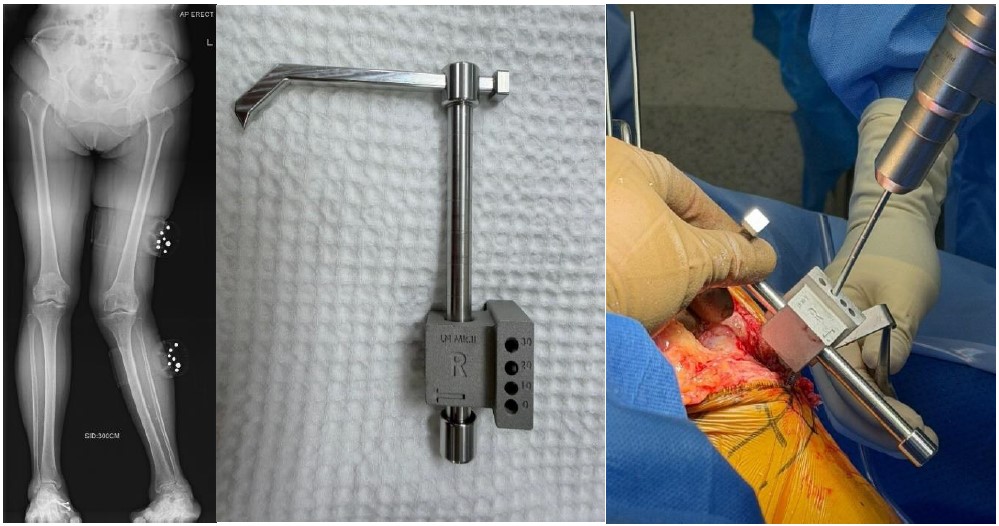
SINGAPORE, 10 February 2026 – For 72-year-old Mdm Law Lai Tee, walking had become a painful ordeal. Her left knee, deformed by severe osteoarthritis, had curved a staggering 26 degrees inwards (the condition is known as ‘severe valgus deformity’) — a rare condition that affects less than 0.5% of patients undergoing knee replacement surgery, globally. Her implants required a 135mm long stabilizing stem in the shin bone, and a 75mm stem in the thigh bone, specifications that verged on the maximum available for such implants. This was not the typical “bow-legged” (varus) deformity which knee surgeons often see in Singapore. Hers was a complex, “knock-knee” (valgus) deformity of extreme severity, involving significant ligament imbalance.
Adjunct Assistant Professor Glen Liau Zi Qiang, an Orthopaedic Surgery Consultant at the Department of Orthopaedic Surgery at Alexandra Hospital and National University Hospital, who performed the surgery in November last year, said it had represented a challenge where precision was key. “In the classification of knee deformities, this is of the highest Grade – a Grade III complex valgus deformity,” explains Dr Liau. “It required not just a standard implant, but a special, more constrained one with additional stem extensions to achieve stability. The margin for error was minute.”
Traditional robotic-assisted Total Knee Arthroplasty (rTKA) depends on stable and accurate tracker pin placement. There is the need for four tracker pins that must be drilled at the start of the operation into the patient’s bones. Pins are specifically required for robotic-assisted knee surgery. They hold tracker arrays that allow the robot to precisely map the position of the bones in real time and guide the surgeon’s cuts with accuracy. With these trackers pinned down, the robotic system can then "see” and adjust to the position of the bones during surgery. The pins are removed towards the end of the operation, leaving additional wounds and holes in the bones that weaken them. “The global rise in robotic knee surgeries has seen a corresponding rise in pin-site related complications,” said Dr Glen Liau. These complications include fractures that originate from the pin holes, wound infections, haematomas, and even, rarely, nerve injuries. The resulting holes become significant structural weak points — "stress risers" that concentrate force, making the bone more likely to fracture. Other than the pin-site related complications, traditional rTKA would involve one main incision on the knee, and two or four additional incisions on the thigh and/or shin. These four additional incisions are for the placement of rigid tracker pins, which hold arrays that allow the robotic system to map the bone in real-time for ultra-precise cuts. Traditional techniques require multiple extra incisions required for tracking pins, would result in additional wounds which in turn result in a higher risk of pin site fractures, infections, post-operative pain, surgical time (for cutting the incisions and suturing to close them), and increased scarring.
Dr Glen Liau and team invented a proprietary, surgical-grade stainless steel intra-incisional tibial pin guide jig, designed to accurately personalise pin positioning and trajectory for each patient. Dr Liau has also published a novel all-intra-incisional surgical technique, which identifies precise positions on the thigh bone, which Dr Liau defined a specific anatomical landmark along the joint's contour, and named it the "Liau-inflection point." From this point, he uses precise measurements, unique to each patient’s anatomy, to safely anchor the pin in the ideal position. For the shin bone, he uses the joint line and prominent bump on the front of the shin as his main reference and places the pin starting position and trajectory accurately using his jig. Through only a single skin incision for the entire operation, all the necessary robotic tracker pins were placed strategically using the patented pin-guide jig, personalised for each patient. Dr Liau has since operated on this ideal bone zone on more than 200 patients to-date and with his invented pin-guide tool or ‘jig’ and surgical technique. An invention for which was also successfully filed a Singapore Patent with IPOS (Intellectual Property Office of Singapore) in October 2025. This method was validated in a study of 102 patients using major robotic total knee arthroplasty systems, with results published in the journal Arthroplasty in 2025.
While freehand pinning techniques can be effective, utilizing Dr Liau’s “Liau-inflection point” anatomical landmark, combined with the self-invented pin-guide jig, further eliminates any element of estimation, and help surgeons accurately execute distances and angular measurements consistently. The pin-guide jig, named “LN Mk. II” for the inventors, namely Dr Glen Liau and his colleague Dr Matthew Ng, features a retractable stylus, laser-marked 1mm depth measurements, and interchangeable guide blocks that allow pins to be inserted at precise, clinically relevant angles of degrees. It is designed for both the left and right knee. “This is a highly precise measuring device,” Dr Liau clarifies. “It further elevates existing traditional and our technique from being a free-hand method of drilling pins to a reliably executable standard of care, with 1 millimeter and 1 degree accuracy, ensuring any surgeon can achieve the same precision. With this accuracy, we have also been able to shorten our single main central incision, making it our surgeries even more minimally invasive.”
In a direct laboratory test, researchers compared the new pin-placement technique to the traditional method using matched cadaver bones. This cadaveric stress testing under 100 Newton-meters of torsional forces (The bones were mounted on specialized machines and subjected to powerful twisting forces until they broke), showed that pin-site fractures occurred with the traditional extra-incisional method—but none were seen with our intra-incisional approach. In addition, bones prepared with the traditional technique fractured 80% of the time, compared to only 30% for those prepared with the new method. Guided by the pin-placement jig and accurate inflection point, the new surgical method provides better bone strength and stronger resistance to fractures, potentially eliminating pin-site fractures.
- Safer - Biomechanically stronger: significantly improves bone torsional strength. Incidence of pin-site fractures reduced.
- Better – Minimally invasive / Within same primary incision length: eliminates additional incision wounds for robotic pins. Reduces bleeding and infection associated with additional incisions.
- Faster: Reduces surgical time needed to create and suture close additional incisions.
“This technique is precise, not affected by patient demographics like age or BMI, and eliminates the need for pin repositioning, offering a viable and safer alternative technique in robotic TKAs,” Dr Liau concluded in his paper. “This potentially translates directly to patient safety. Immediately after knee replacement surgeries, we typically encourage our patients to fully weight bear and walk. During this early recovery period, if a patient accidentally has a fall and/or forcefully twists to the side, using our All-intra-incisional pin placement technique, the patient’s bone is biomechanically much stronger and less likely to sustain a catastrophic fracture originating from those pin holes,” he added.
A month post-surgery, Mdm Law was on the road to recovery, her severe deformity corrected without the additional wounds, pain, and potential complications of the traditional method. Mdm Law said, "Before the surgery, my leg was bent so badly inwards that every step was painful and unstable. I was worried it was too complex to fix. Dr Liau explained his new method would need only one cut. Today, my leg is straight again. The relief is not just in the knee, but knowing I didn't have extra wounds to heal from and worry about."
Dr Liau’s award winning work was recognized internationally, at the American Association of Hip and Knee Surgeons 2025 Conference (Awarded Top 100 research projects, out of nearly 3000 projects). His research study also won the First Prize at the leading Thai Hip & Knee Society (THKS) Conference in 2025.
The complementary synergism of Dr Liau’s patented AI (Artificial Intelligence) algorithm for robotic total knee replacement (rTKA) that enhances precision in surgical planning which helps with final implant placement, together with his patented surgical pin-guide jig and surgical technique, aims to bring better outcomes to patients undergoing robotic knee replacements.
“My team continues to push for innovative techniques and solutions, because all knee replacement patients deserve the highest performing outcomes,” says Dr Liau. “In sharing our techniques, inventions and findings, we hope that more patients will benefit from safer and better knee replacements in future.”
-End-